
STREETCAR HISTORY
EDMONTON STREETCAR HISTORY
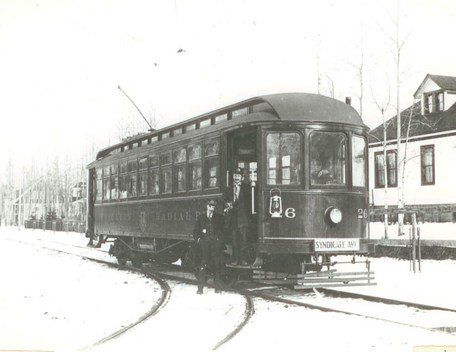
Edmonton Streetcar #26 newly delivered from the Ottawa Car Company stands at 24 (124) Street and Athabasca (102) Avenue ready to return to Syndicate Avenue (95 Street) in this 1911 scene.
What is a Streetcar ?
A streetcar is a public transportation vehicle (car) that runs on rails laid down on the street. It can also be called a trolley or a trolley-car, and outside North America in English speaking countries it is referred to as a tram or tramcar.
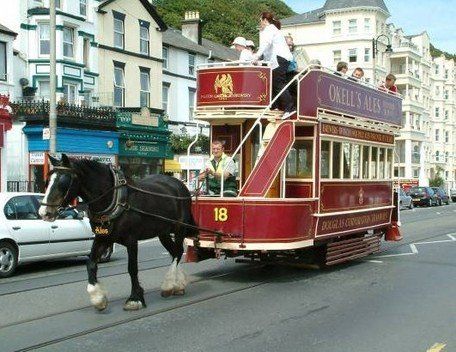
Horse Trams in Douglas, Isle of Man still run
every summer since 1876!
The Beginnings
In New York around 1830 a young Irishman, John Stephenson, had a brainwave! Why not run a railroad along a street? He developed the idea and the first public streetcar line was opened in New York on November 26, 1832. The cars were hauled by horses.
The "street railway" idea slowly began to spread. New Orleans ran its first streetcars in 1834, (and they continue to this day), and by the 1880's most major cities in the U.S., Britain and Europe were running horse-drawn streetcars. Their great advantage over horse-drawn omnibuses was the "smooth" ride provided by steel wheels running on steel rails. Bus passengers had a dreadful ride over very uneven and rutted street surfaces.
Although early streetcars were horse-drawn, other methods of haulage were adopted including cable haulage (still in use in San Francisco) and steam haulage (especially in the British Isles and Europe where the cars were actually towed by small steam engines along the streets!) These early modes of traction were soon to become obsolete because of the new miracle of the age - electricity!
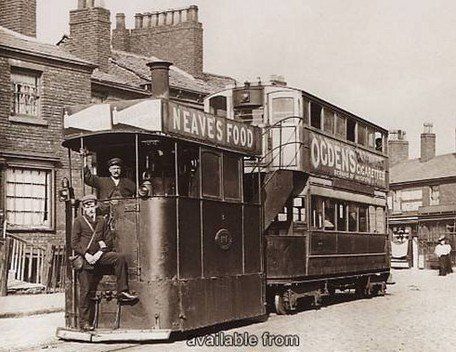
Steam engine hauling a double-deck tram
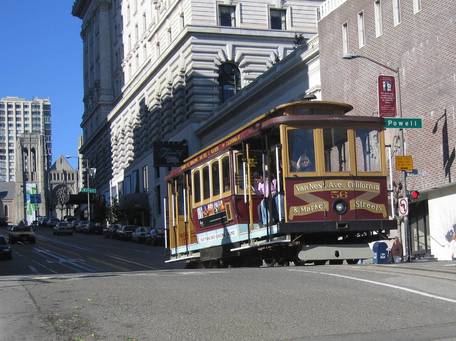
The San Francisco cable cars are world famous and continue to run.
The Electric Era
With the development of the electric motor the streetcar industry was revolutionized and this led to an enormous increase in the number of systems throughout the world. Compared to other modes of transportation, the electric streetcar was fast, frequent, clean, reliable and inexpensive to operate. It provided easy travel to all parts of cities. By the early 1900s virtually every city in North America had a streetcar system, and indeed these contributed to the growth and expansion of many cities.
Electricity to propel the cars was normally supplied by the overhead wire system where the cars picked up the current by means of a long pole fixed to the roof of each car. This was simple and relatively cheap to construct as well as being easy to adjust and repair. Later in some areas (especially European cities) the pole was superseded by a bow collector or a pantograph. (In a few cities such as London and Washington D.C. overhead wires were not permitted in the central area and a conduit system was used for current collection. It was picked up by means of a "plough" carried on the truck under the car and passing down through a narrow slot provided in the conduit fixed below the road surface.)
Several manufacturers dominated the streetcar industry in North America. Edmonton's first cars were supplied in 1908 by the Ottawa Car Manufacturing Company, and subsequent orders were placed with the St. Louis Car Company and the Preston Car Manufacturing Company. Some cities built cars in their own workshops. As well, several companies such as Brill and Peckham developed different designs of streetcar trucks and these were supplied to the various car body manufacturers.
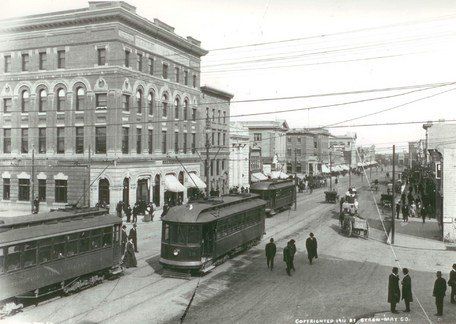
Jasper Avenue & First (101 Street) in 1911
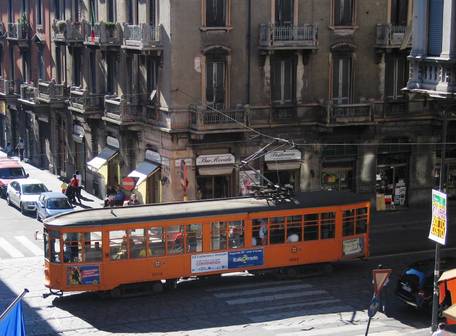
Peter Witt streetcars were introduced to Milan (Italy) in 1928. 80 years later, 150 cars are still in service!
(August 30, 2006)
Decline and the "PCC" Era
While streetcars were dominant for many years, the advent of the motor bus and the private automobile led to stiff competition. To challenge rising costs and falling receipts a prototype car of a revolutionary design was unveiled in 1934. This P.C.C. (Presidents' Conference Committee) streetcar accelerated smoothly instead of jerking from one notch of the controller to the other. The driver sat at a control console and operated the car by an organ-pedal accelerator. With lightweight motors and rubber-cushioned wheels the car glided along almost noiselessly. Hopes were high that this new design would attract riders back to streetcars and challenge bus competition. By 1940 some 1,100 PCC cars had been built for many of the major operators in the United States.
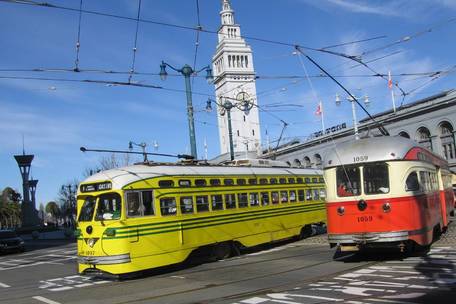
Typical PCC cars working the F-Line in San Francisco (January 13, 2007)
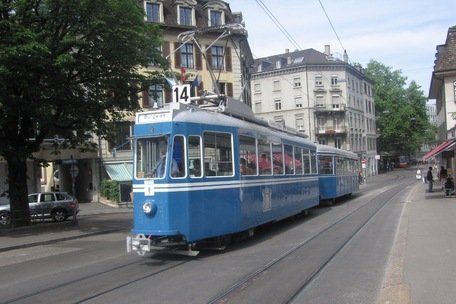
This Swiss Standard Car was built in 1950 and is now part of the Zurich museum fleet
(May 26, 2007)
Although some systems had been abandoned by the 1930s many major cities continued to operate electric streetcars through World War II. Fuel restrictions lead to record passenger loads, resulting in worn-out cars and tracks. Those cities that had not updated their fleets were now reluctant to make a major capital investment to rehabilitate their track and rolling stock, the result being that many systems closed down. (In Europe, apart from the United Kingdom, streetcars continued to play a major role in public transportation.) Trolleybus or diesel bus substitution became the order of the day. The PCC car had arrived on the scene too late to stop the tide of streetcar abandonment.
Revival - The "Light Rail" (LRT) Era
By the end of the 1960s a mere handful of cities in North America (including Toronto) continued to operate streetcars. The situation in Europe, however, was rather different with total abandonment being the exception rather than the rule (although Paris had ended in 1937 and London in 1952). With economic recovery as well as redevelopment after World War II, most of the surviving systems had been modernized with new cars, stretches of private right-of-way and in some cases tracks being placed in tunnels in city centres. These efficient systems became the forerunners of what we now refer to as "light rail" or LRT. The flexibility and relatively inexpensive cost of construction made such systems an attractive alternative to "heavy" rapid transit subways or metros. For cities with populations below one million this has become the preferred mode. The first city to adopt the "European" model in North America was Edmonton, whose light rail system opened in 1978.
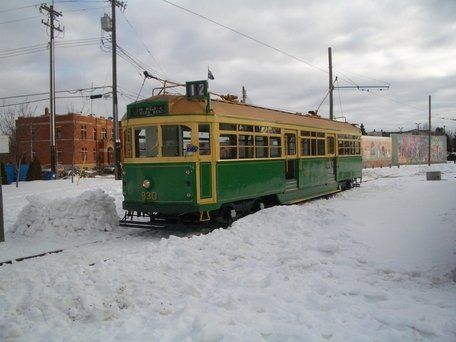
Melbourne (Australia) SW6 class car originates from 1947 and works now on the Edmonton High Level Bridge Line
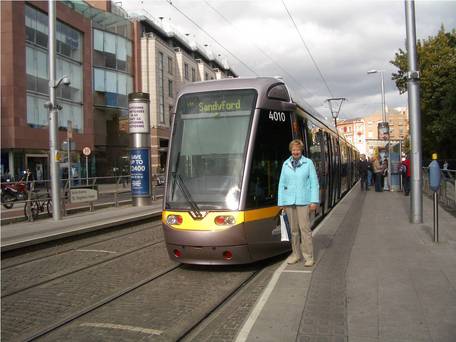
A brand new tram system operates in Dublin, Ireland
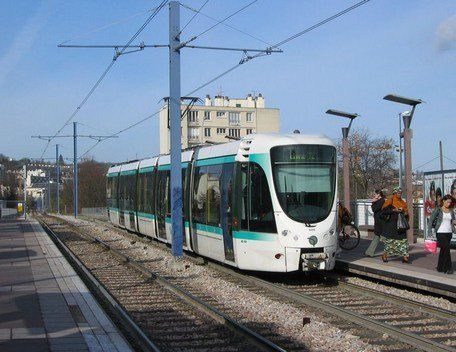
After more than six decades, streetcars have come back to Paris, France
Edmonton Radial Railway Society
P.O. Box 76057 Southgate P.O.
Edmonton, Alberta T6H 5Y7
The Edmonton Radial Railway Society operates on Treaty 6 territory, a traditional meeting grounds, gathering place, and travelling route to the Cree, Saulteaux, Blackfoot, Métis, Dene and Nakota Sioux. We acknowledge all the many First Nations, Métis, and Inuit whose footsteps have marked these lands for centuries.